
Top 6 Technology Development Challenges
Remaining in Autism Support (2026)
We are actively studying the most promising innovations to help children with autism thrive in school, at home, and in the community. This page highlights the six highest-potential technologies — ranked by current scientific promise — and the real-world development challenges that still need to be solved.
Starting with ESDM augmented by robotics and working down to emerging solutions.
ESDM Augmented with Robotics (Most Promising)
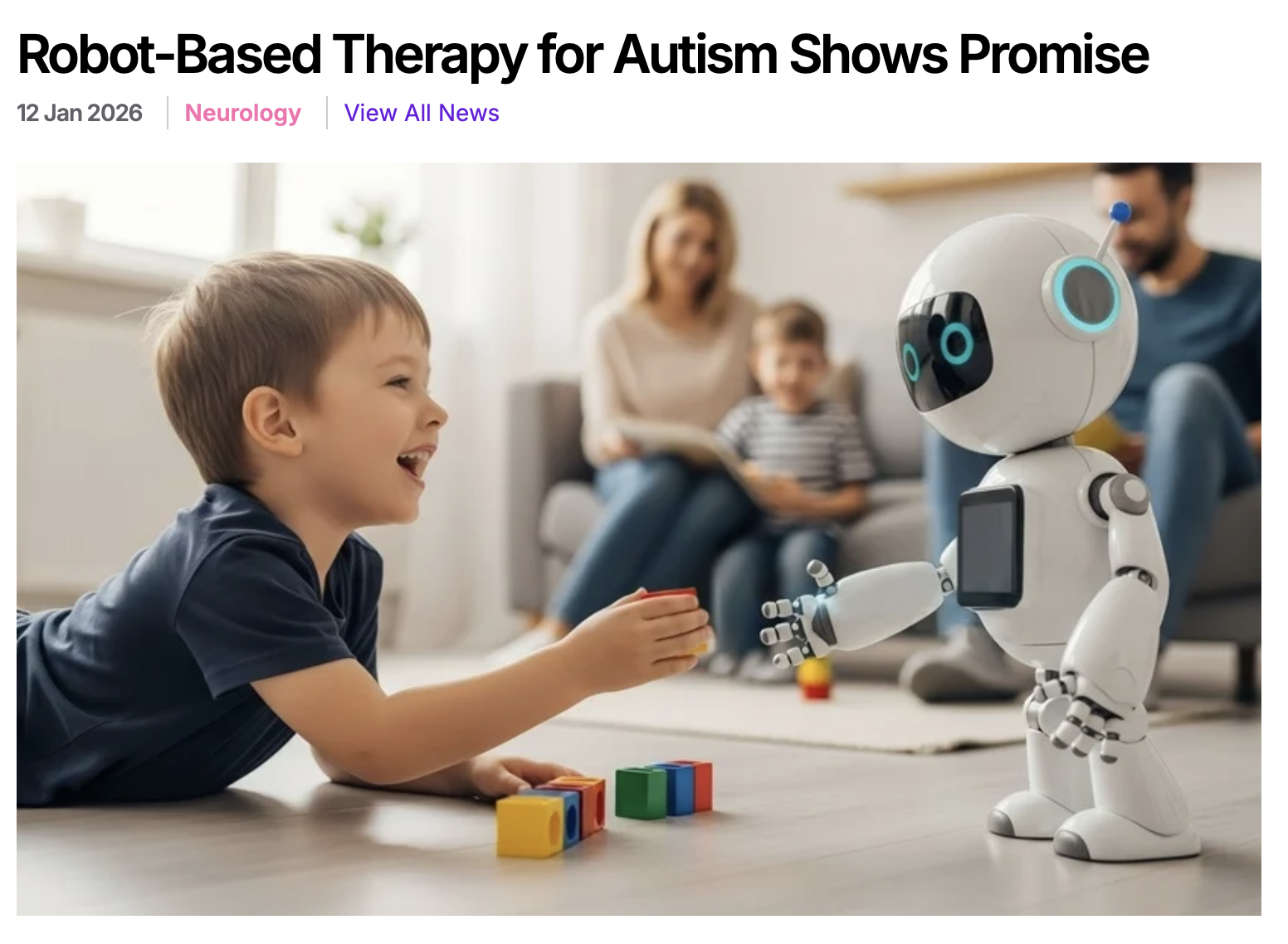
The Early Start Denver Model (ESDM) + telerobotics/telepresence robots (e.g., Pepper robot in the I-ROBI pilot) uses a therapist-controlled robot to boost engagement, attention, and communication during naturalistic, play-based ESDM sessions.
Why promising: Combines proven early-intervention outcomes with robotics’ consistency and motivation boost; first-of-its-kind pilots show feasibility in care settings.
Remaining Development Challenges
- Limited robot dexterity restricts full play-based interactions therapists normally perform
- Small sample sizes and single-case designs limit generalizability across the heterogeneous autism spectrum
- Requires constant on-site therapist teleoperation, reducing scalability
- Need for larger, multi-site RCTs to prove long-term skill generalization and clinical significance
Immersive VR/AR/XR Platforms
Virtual and extended reality systems (e.g., Floreo, iKNOW/VOISS) create safe, repeatable environments for practicing social skills, emotional regulation, and school scenarios with real-time teacher/parent analytics.
Why promising: Strong RCTs, FDA Breakthrough Device status for some platforms, and proven gains in engagement and generalization.
Remaining Development Challenges
- High equipment cost and accessibility barriers, especially in low-resource or school settings
- Balancing technology with essential human therapist relationships and neuro-affirming design
- Insufficient data on children with co-occurring intellectual disabilities or sensory sensitivities
- Therapist training gaps and inconsistent study designs that hinder broad adoption and insurance coverage
AI-Powered Adaptive Platforms & Real-Time Progress Monitoring
AI dashboards and apps (e.g., Motivity, Jiguar, integrated LMS like SpectrumSphere) deliver personalized learning, automatic IEP tracking, and instant parent/teacher insights across home and school.
Why promising: Real-time data closes the gap between therapy, school, and family; systematic reviews show strong gains in adaptive functioning.
Remaining Development Challenges
- Data privacy, security, and ethical use of sensitive behavioral/physiological information
- “Black-box” AI decisions that lack explainability for clinicians and families
- Fragmented integration across existing school/therapy systems
- Need for longitudinal real-world validation beyond controlled trials
Socially Assistive Robotics in the Classroom
Robots such as QTrobot, Milo, or emerging AI humanoids serve as consistent teaching aides for emotion recognition, turn-taking, and social play while collecting behavioral data.
Why promising: Multiple 2025 RCTs show engagement levels far above traditional methods with equivalent or better skill outcomes.
Remaining Development Challenges
- High purchase/maintenance costs and classroom fragility concerns
- Teacher training time and lesson-prep burden
- Novelty effects, potential dependency, and sensory overload for some children
- Ethical questions around robot “replacement” of human interaction and long-term efficacy data
Wearable Biofeedback & Physiological Monitoring
Smart wearables and EDA/heart-rate sensors provide real-time stress alerts, trigger identification, and calming-strategy insights for parents and teachers.
Why promising: Objective data bridges subjective parent reports and enables proactive meltdown prevention.
Remaining Development Challenges
- Accuracy and comfort for active children during full school days
- Integration of physiological data with behavioral/IEP platforms
- Privacy concerns with continuous monitoring of vulnerable children
- Limited large-scale evidence on real-world generalization and family adoption
Brain-Computer Interfaces (BCI) & Neurofeedback
EEG-based neurofeedback games and BCI-VR systems train attention, emotion regulation, and social cognition through brain-signal feedback.
Why promising: Feasibility trials show direct impact on core ASD symptoms and brain activity changes.
Remaining Development Challenges
- Poor signal-to-noise ratio and low spatial resolution in pediatric EEG/fNIRS
- Comfort and engagement issues for young children with sensory sensitivities
- Inconsistent results across studies; need for standardized protocols and larger RCTs
- High technical complexity and cost barriers to classroom or home scaling
At AutismTech Forward, we don’t just watch these challenges — we study them, partner with researchers, and design solutions that address the real barriers to adoption. Our goal is scalable, affordable, teacher- and family-friendly technology that builds on the strongest evidence base available.
Partner With Us to Solve These ChallengesTop 6 Technology Development Challenges
Remaining in Autism Support (2026)
We are actively studying the most promising innovations to help children with autism thrive in school, at home, and in the community. This page highlights the six highest-potential technologies — ranked by current scientific promise — and the real-world development challenges that still need to be solved.
Starting with ESDM augmented by robotics and working down to emerging solutions.
ESDM Augmented with Robotics (Most Promising)
The Early Start Denver Model (ESDM) + telerobotics/telepresence robots (e.g., Pepper robot in the I-ROBI pilot) uses a therapist-controlled robot to boost engagement, attention, and communication during naturalistic, play-based ESDM sessions.
Why promising: Combines proven early-intervention outcomes with robotics’ consistency and motivation boost; first-of-its-kind pilots show feasibility in care settings.
Remaining Development Challenges
- Limited robot dexterity restricts full play-based interactions therapists normally perform
- Small sample sizes and single-case designs limit generalizability across the heterogeneous autism spectrum
- Requires constant on-site therapist teleoperation, reducing scalability
- Need for larger, multi-site RCTs to prove long-term skill generalization and clinical significance
Immersive VR/AR/XR Platforms
Virtual and extended reality systems (e.g., Floreo, iKNOW/VOISS) create safe, repeatable environments for practicing social skills, emotional regulation, and school scenarios with real-time teacher/parent analytics.
Why promising: Strong RCTs, FDA Breakthrough Device status for some platforms, and proven gains in engagement and generalization.
Remaining Development Challenges
- High equipment cost and accessibility barriers, especially in low-resource or school settings
- Balancing technology with essential human therapist relationships and neuro-affirming design
- Insufficient data on children with co-occurring intellectual disabilities or sensory sensitivities
- Therapist training gaps and inconsistent study designs that hinder broad adoption and insurance coverage
AI-Powered Adaptive Platforms & Real-Time Progress Monitoring
AI dashboards and apps (e.g., Motivity, Jiguar, integrated LMS like SpectrumSphere) deliver personalized learning, automatic IEP tracking, and instant parent/teacher insights across home and school.
Why promising: Real-time data closes the gap between therapy, school, and family; systematic reviews show strong gains in adaptive functioning.
Remaining Development Challenges
- Data privacy, security, and ethical use of sensitive behavioral/physiological information
- “Black-box” AI decisions that lack explainability for clinicians and families
- Fragmented integration across existing school/therapy systems
- Need for longitudinal real-world validation beyond controlled trials
Socially Assistive Robotics in the Classroom
Robots such as QTrobot, Milo, or emerging AI humanoids serve as consistent teaching aides for emotion recognition, turn-taking, and social play while collecting behavioral data.
Why promising: Multiple 2025 RCTs show engagement levels far above traditional methods with equivalent or better skill outcomes.
Remaining Development Challenges
- High purchase/maintenance costs and classroom fragility concerns
- Teacher training time and lesson-prep burden
- Novelty effects, potential dependency, and sensory overload for some children
- Ethical questions around robot “replacement” of human interaction and long-term efficacy data
Wearable Biofeedback & Physiological Monitoring
Smart wearables and EDA/heart-rate sensors provide real-time stress alerts, trigger identification, and calming-strategy insights for parents and teachers.
Why promising: Objective data bridges subjective parent reports and enables proactive meltdown prevention.
Remaining Development Challenges
- Accuracy and comfort for active children during full school days
- Integration of physiological data with behavioral/IEP platforms
- Privacy concerns with continuous monitoring of vulnerable children
- Limited large-scale evidence on real-world generalization and family adoption
Brain-Computer Interfaces (BCI) & Neurofeedback
EEG-based neurofeedback games and BCI-VR systems train attention, emotion regulation, and social cognition through brain-signal feedback.
Why promising: Feasibility trials show direct impact on core ASD symptoms and brain activity changes.
Remaining Development Challenges
- Poor signal-to-noise ratio and low spatial resolution in pediatric EEG/fNIRS
- Comfort and engagement issues for young children with sensory sensitivities
- Inconsistent results across studies; need for standardized protocols and larger RCTs
- High technical complexity and cost barriers to classroom or home scaling
At AutismTech Forward, we don’t just watch these challenges — we study them, partner with researchers, and design solutions that address the real barriers to adoption. Our goal is scalable, affordable, teacher- and family-friendly technology that builds on the strongest evidence base available.
Partner With Us to Solve These Challenges